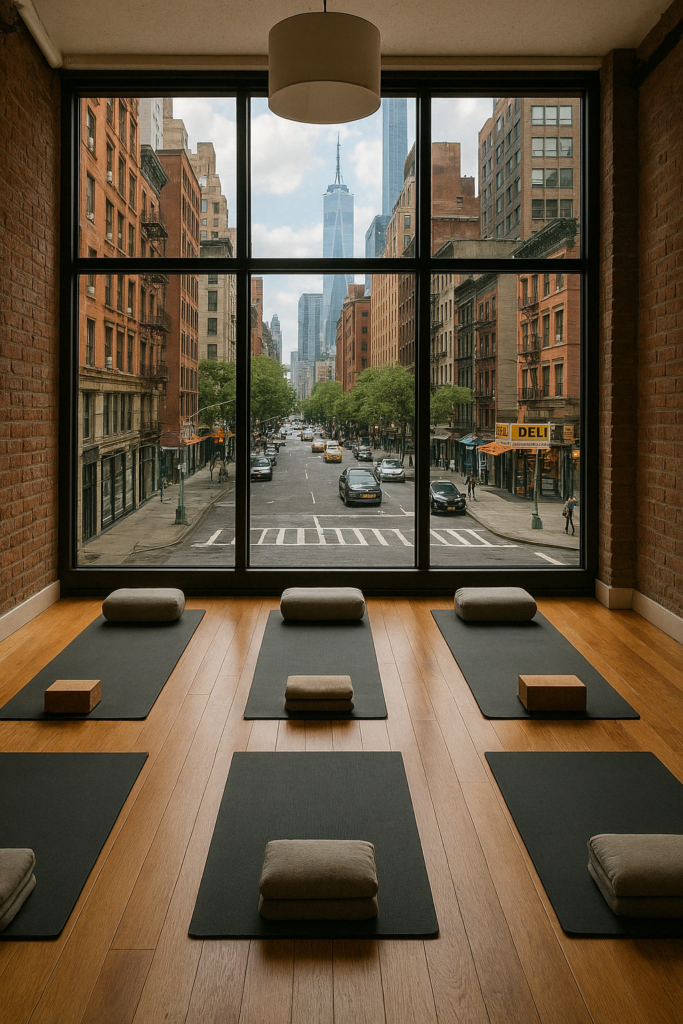
There’s a third-floor loft on Church Street in TriBeCa where time doesn’t work the way it does outside. No clocks. No windows to the street. Just a room bathed in magenta light and filled with a sound that seems to come from everywhere and nowhere — a deep, continuous, mathematically precise hum that changes shape as you move your head.
This is the Dream House, and it’s been running, nearly uninterrupted, for over 30 years. It might be the strangest, most beautiful thing happening in New York City that almost nobody knows about.
What Exactly Is the Dream House?
The Dream House is a “sound and light environment” — a collaboration between minimalist composer La Monte Young and multimedia artist Marian Zazeela. Young composes the sound: a 32-tone sine wave composition generated by a Rayna synthesizer, producing continuous drones tuned to precise mathematical ratios. Zazeela creates the light: magenta-hued sculptures and lighting that transform the room into something between a meditation chamber and another dimension.
The result is an immersive installation where the sound literally changes depending on where you stand. Move your head six inches to the left, and one frequency gets louder while another fades. Take a step forward, and entirely new overtones emerge. The room is playing you as much as you’re listening to it.
A Sound That’s Been Playing for Decades
Young began formulating the concept in 1962, drawing on his larger work The Turtle, His Dreams and Journeys, which he started in 1966 and has continued ever since. The first public Dream House premiered in Munich in 1969, followed by a version at the Metropolitan Museum of Art in 1971. The 1975 Dream Festival — a two-month series in SoHo — cemented the concept.
The current TriBeCa installation opened in 1993 above Young and Zazeela’s own loft. It has run seasonally ever since, making it one of the longest-running art installations in the city. Artforum called it a “landmark conceptual artwork.” The New York Times described it as an “urban refuge.”
In recent years, the Dia Art Foundation acquired the Dream House as a permanent work, ensuring its future even as funding challenges have occasionally threatened its continuity. The current exhibition at the MELA Foundation runs through June 21, 2026.
What It Feels Like Inside
You climb to the third floor of an unremarkable Church Street building. You remove your shoes — this is required. You open the door, and the sound hits you like a warm wall. It’s not loud, exactly, but it’s everywhere. The magenta light makes the room feel like the inside of a sunset.
Most visitors sit on the floor. Some lie down. Some walk slowly around the room, discovering how the sound changes with each step. There’s no tour guide, no audio explanation, no timeline of the artists’ careers on the wall. Just the hum and the light and your own brain trying to figure out what’s happening.
The effect is deeply individual. Some people find it meditative and stay for an hour. Others find it unsettling and leave after five minutes. There is no wrong response. The installation was designed to be experienced, not understood — though understanding deepens the experience enormously.
Why This Matters
La Monte Young is widely considered the father of minimalist music — the composer who influenced everyone from Terry Riley to Brian Eno to the Velvet Underground. The Dream House is the purest expression of his life’s work: the idea that a single sustained sound, held long enough and tuned precisely enough, can become a world.
Zazeela’s contribution is equally essential. Without the magenta light, the sound would just be sound. Together, the two create what Zazeela described as “a new form” — something that’s not quite music, not quite visual art, and not quite architecture, but occupies a space where all three intersect.
In a city drowning in immersive experiences — Van Gogh projections, AI-generated spectacles, Instagram pop-ups — the Dream House stands apart because it was doing this before “immersive” was a marketing buzzword. It’s been here since 1993, humming quietly on Church Street, waiting for you to take off your shoes and step inside.
How to Visit
Address: MELA Foundation, 275 Church Street, 3rd Floor (between Franklin and White Streets), TriBeCa, Manhattan
Nearest Subway: Franklin Street (1 train) or Canal Street (A, C, E, N, Q, R, W, J, Z, 6 trains)
Hours: Wednesday through Saturday, 2:00 PM – 10:00 PM (current exhibition through June 21, 2026)
Admission: $10
Phone: (917) 603-9715
Website: melafoundation.org
Insider Tip: Go late — the evening hours (after 7 PM) tend to be quieter, and the experience is more powerful with fewer people in the room. Wear comfortable clothes you can sit on the floor in. And give yourself at least 20 minutes; the installation reveals itself slowly, and the first five minutes are just your brain adjusting. If you’re in the neighborhood, pair this with a visit to The Django jazz club afterward — TriBeCa rewards explorers who stay out late.
New York has thousands of galleries and museums. It has exactly one room where the air itself is a musical instrument. The Dream House has been TriBeCa’s best-kept secret for over three decades, and every time you visit, the sound shows you something different. Go before June, and go with an open mind.