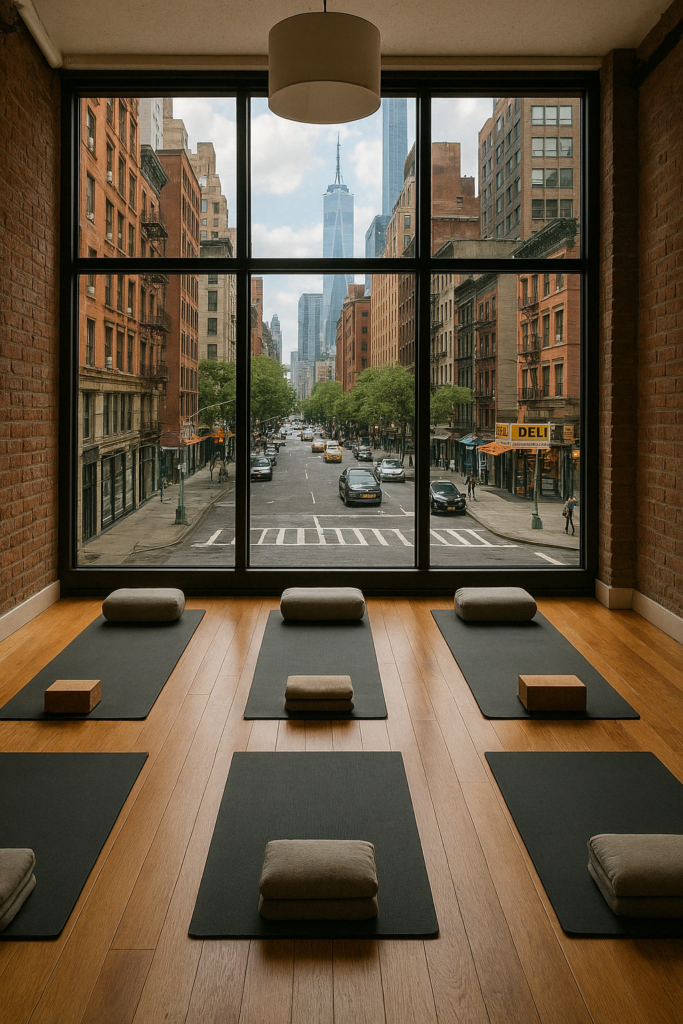
The pilgrim’s first day in New York City is the one most travelers waste. They land in a fog of jet lag, take a $90 taxi to a hotel that won’t check them in for four more hours, drop a bag with a bellhop they tip badly, and then drift into Times Square because they cannot think of anywhere else to go. Six hours later they are sunburnt, $200 lighter, and they have eaten a hot dog they did not enjoy. The city has not happened to them yet. It has only happened around them.
This is a sequencing problem. New York is not hostile to first-time visitors, but it does not slow down to explain itself. The pilgrim who arrives without a plan for the gap between landing and dinner ends up at the mercy of whatever’s nearest. The pilgrim who has sequenced the day — even loosely — walks into the city with leverage. What follows is not an itinerary. It is the order of operations that experienced visitors use to convert a chaotic arrival into a coherent first day. Use it as scaffolding. Replace the specifics with your own pilgrim priorities — theater, literature, jazz, food, art — and the sequence still holds.
Hour Zero: Land With Your Payment Method Already Loaded
The single highest-leverage decision a first-time pilgrim makes happens before the wheels touch the runway. Decide which tap-to-pay card or device you are going to use for every single transit ride in New York. Then use only that one for the entire trip. This is not a stylistic preference. The MTA’s fare-capping system runs per payment method, which means if you tap with your phone on Monday and your physical Visa on Tuesday, you are running two separate fare caps and you will not hit either one. According to the MTA, the cap kicks in only after twelve paid trips in a seven-day window on the same payment method. Mix methods and you forfeit the savings.
The numbers worth memorizing before you leave home: a single subway or local bus ride is $3. The weekly cap is $35 for subway and local bus combined. If you might take an express bus from the airport or to an outer borough, the combined cap is $67. Reduced-fare riders cap at $17.50. After twelve trips in seven rolling days, the rest of your taps that week are free. There is no pass to buy, no app to download, no card to load. The contactless card already in your wallet is the system. As of January 2026, you can no longer buy or refill a MetroCard, so do not arrive expecting to find one at the airport. The vending machines now dispense OMNY cards, but you will not need one if your phone or contactless card works.
Why this matters at hour zero: the moment you tap into the AirTrain or the subway, your fare-cap clock starts. Every subsequent decision about how to get around the city — including the small luxuries like taking a cab when it rains — gets cheaper if you commit to one card early and let the cap absorb the rest of the week.
Hours One Through Three: The Bag-Drop Window, Not the Check-In Window
Most hotels in New York will not let you check in before 3:00 or 4:00 p.m. Many pilgrims land at 11:00 a.m. and read this as a problem. It is not. It is the city’s gift. The bag-drop window — the three to five hours between landing and check-in — is the most valuable orientation time you will get on the entire trip, because you are unencumbered, you are walking, and you have not yet committed to a neighborhood.
The mentor move is this: do not check in. Drop the bag. Every full-service hotel in Manhattan will hold your luggage at the bell desk from the moment you arrive. Hand it over, tip the bellhop two or three dollars per bag in cash, take the claim ticket, and walk back out the door. You are now a free pilgrim with a key the city cannot yet make you use. This is the only window on your trip when you have no obligation, no reservation pulling you anywhere, and no decision fatigue. Spend it walking, not sitting.
If you are staying in Midtown — which most first-time pilgrims are, whether by accident or design — the immediate move is to leave Midtown. Take the subway or walk south into a neighborhood that has actual texture. The blocks immediately around Times Square will still be there at dinnertime. The West Village, Greenwich Village, Chelsea, and the Lower East Side reward an unencumbered afternoon in a way that the Broadway corridor cannot.
The First Subway Ride Is the Orientation
If you have only one chance to learn the subway, take it now, on the first day, when you have no time pressure. The first ride you take in New York should be a deliberate one — not a panicked dash to a show or a late dinner. Walk to the nearest station. Look at the entrance signage. The green globe means the entrance is open at all hours. The red globe means the entrance is restricted — check the sign before going down the stairs to confirm whether it is exit-only or limited-hours.
Tap in with the card you committed to in the airport. Pay attention to two things: the direction labels (uptown vs. downtown, Manhattan-bound vs. Brooklyn-bound) and the difference between local and express trains. On the lines that matter most to visitors — the 1/2/3, the 4/5/6, the A/C/E, and the N/Q/R/W — local trains stop at every station and express trains skip most of them. The map at the platform shows which trains stop at which stations with a white dot for local, a black dot for express. If you board an express by mistake and watch your station blur past, get off at the next stop and ride one stop back on the local. This is not an emergency. It is the rite of passage every visitor goes through once.
Remember the transfer rule: you get one free transfer within two hours of your first tap, using the same payment method. That means a single $3 tap covers a subway ride, a transfer to a bus, and back to a subway — if you do it inside the two-hour window. This is the architecture that makes the $35 weekly cap so generous in practice.
The Anchor Stop: The Official Information Center
Most first-time pilgrims do not know this exists, and it is worth a specific subway trip on day one. The Official NYC Information Center, operated by NYC Tourism and Conventions, is inside Macy’s Herald Square at 151 W. 34th Street, between Seventh Avenue and Broadway. It is open Monday through Saturday from 10:00 a.m. to 10:00 p.m. and Sunday from 10:00 a.m. to 9:00 p.m., closed only on Thanksgiving Day and Christmas Day. Eight subway lines stop within one block: the B, D, F, M, N, Q, and R at 34th Street–Herald Square, and the 1, 2, 3, A, C, and E at 34th Street–Penn Station.
Why bother going in person when the same information exists online? Because the staff at the desk know which Broadway shows have last-minute rush tickets that day, which museums are running free hours that night, and which neighborhood events you would never find on a tourism homepage. They will also hand you paper maps — and a paper map of Manhattan, folded into your pocket, is a sanity instrument when your phone dies on the subway and you cannot remember whether your hotel is east or west of Sixth Avenue. The information center is also a useful psychological anchor: now you know exactly where the city’s official welcome desk is, and if anything goes wrong later in the trip, you have a place to return to that is not your hotel lobby.
Late Afternoon: Check In, Reset, Re-Layer
Sometime between 3:30 and 4:30 p.m., loop back to the hotel and check in for real. This is the moment your trip changes shape. Drop the day pack, change socks, splash water on your face, and look at the actual weather forecast for the evening — not the morning’s. New York’s temperature can swing fifteen degrees between a sunny afternoon and a windy waterfront evening, and the pilgrim who layers down for dinner is the one who is not miserable by the encore.
Use the hotel reset deliberately. Do not nap. A nap on the first day in New York is a one-way ticket to being awake at 3:00 a.m. and groggy through your first morning. The better move: a hot shower, a glass of water, fifteen minutes lying flat with your eyes closed but not asleep, and back out the door. The body will catch up overnight if you give it the chance.
Dinner: Eat Where the Pilgrim Belongs, Not Where the Crowd Goes
The first dinner is the one most pilgrims overspend on. The trap is the assumption that a “famous” restaurant is the right way to mark the arrival. It is not. A famous restaurant on day one means a forty-five-minute wait, a server who has done this rotation eight times today, and a meal you will not remember. The mentor move is to eat somewhere unobtrusive and well-run on the first night — a neighborhood Italian place in Greenwich Village, a Vietnamese spot in the East Village, a slice from a coal-oven pizzeria — and save the marquee reservations for nights two through four, when your body has adjusted and your palate is paying attention.
Two practical mechanics here that catch pilgrims off guard. First, New York City sales tax adds 8.875 percent to your check. It is not included in the menu price. Second, tipping is not optional. The cultural floor is 18 percent on the pre-tax total; 20 percent is the polite norm in a sit-down restaurant; 25 percent at a place you’d return to. Some restaurants now print a “suggested tip” line on the check that calculates 18, 20, and 22 percent for you. Use it as a sanity check, not as the only option. Counter-service spots — bagel shops, delis, pizza-by-the-slice — do not require a tip but a dollar in the jar is appreciated and remembered.
Evening: One Activity, Not Three
The pilgrim’s mistake on the first night is trying to fit in a Broadway show, a rooftop bar, and a walk across the Brooklyn Bridge. Pick one. The body has been awake for fourteen hours, possibly across time zones. A single, well-chosen evening activity becomes a memory. Three rushed ones become a blur.
If your pilgrim canon is theater, this is the night for a smaller off-Broadway production rather than a Broadway marquee — lower-stakes, easier seats, and your first-night attention won’t be wasted on a show you’ve been anticipating for a year. If literature is your spine, walk Washington Square Park at dusk and find the bench Henry James wrote about. If jazz, find a 9:30 set somewhere small in the Village rather than the late show at the famous club. The famous shows reward a rested pilgrim. The first night belongs to atmosphere over destination.
Before Bed: The Sequence That Saves Day Two
Three small acts before you sleep on the first night, in this order. First, check the MTA’s planned service changes page for tomorrow morning’s routes — weekend and overnight work routinely reroutes the very trains you were counting on, and finding out at 8:00 a.m. on a platform is worse than finding out at 11:00 p.m. in bed. Second, set tomorrow’s first activity to something within walking distance of the hotel, so that if jet lag hits hard you can still execute it on foot. Third, drink a full glass of water and set out clothes for the morning. The pilgrim who hydrates and pre-decides what to wear is the pilgrim who walks out the door at 9:00 a.m. instead of 11:00 a.m.
What This Sequence Buys You
The pilgrim who runs this sequence on day one is not racing to see things. They are establishing the operating system for the rest of the trip — payment method committed, subway literacy banked, information center located, hotel reset rehearsed, restaurant mechanics absorbed. By the time day two begins, every subsequent decision in New York costs less mental effort, because the foundational ones are already made. That is what a first day in New York is for. Not to consume the city, but to learn how to be inside it.
The visitors who treat day one as a checklist of attractions leave the city feeling like they did everything and remember none of it. The pilgrims who treat day one as orientation walk into day two already feeling like they live there — at least a little, at least enough — and that is the threshold that separates a tourist from a traveler.
The 46-Day Pilgrim Capture
Are you within 46 days of your first NYC trip? The orientation work above is the foundation. The next layer — neighborhood-by-neighborhood routing, day-by-day sequencing for your specific pilgrim canon (Broadway, literary, jazz, art, food), and pre-departure decisions — is what we send to pilgrims inside the 46-day window.
Drop your trip date and your pilgrim type below and we will send the next set of orientation materials, timed to your departure.
[Capture form embed]
Frequently Asked Questions
What is the fastest way to pay for the subway as a first-time visitor?
Tap your contactless credit or debit card, smartphone, or wearable device on the OMNY reader at the turnstile. No sign-up required. Use the same payment method for every ride to trigger the weekly fare cap.
How much does the subway cost in 2026?
$3 per ride for most riders on subways and local buses. Express buses are $7.25. Weekly fare cap is $35 for subway and local bus combined; $67 if you include express buses.
Can I still use a MetroCard?
You can still ride with an existing MetroCard until cash and MetroCard acceptance ends in 2026 (exact date pending MTA announcement), but as of January 1, 2026, you can no longer buy or refill them. Transfer remaining value to an OMNY card at a Customer Service Center.
Where is the official NYC visitor information center?
Inside Macy’s Herald Square at 151 W. 34th Street, between Seventh Avenue and Broadway. Open Mon–Sat 10am–10pm, Sun 10am–9pm. Closest subway: 34th Street–Herald Square (B/D/F/M/N/Q/R) or 34th Street–Penn Station (1/2/3/A/C/E).
Do hotels in NYC hold luggage before check-in?
Yes. Every full-service Manhattan hotel will hold your bags at the bell desk before check-in. Tip $2–$3 per bag in cash. This frees you to walk the city during the bag-drop window between arrival and check-in.
What should I tip at a NYC restaurant?
The cultural floor at a sit-down restaurant is 18 percent on the pre-tax total. Twenty percent is the polite norm; 25 percent at a place you’d return to. Counter service does not require a tip. New York City sales tax adds 8.875 percent on top of the listed menu price.
What is the free transfer rule?
You get one free transfer within two hours of paying your fare, using the same payment method. You can transfer subway-to-bus, bus-to-subway, or bus-to-bus.
Sources: MTA fare and tap-and-ride information confirmed at mta.info/fares-tolls/subway-bus. Fare cap mechanics confirmed at omny.info/faq/fare-cap. Official NYC Information Center address and hours confirmed at nyctourism.com/official-nyc-info-center.